

What is brand?
FIELD JOURNAL:I played football at Drake University. Blue and white, the bulldog, a tradition older than anyone who's ever run out onto that field. One season I turned my camera on it and cut a hype video. Thousands of people watched. Teammates, the athletic office, students, parents, alumni who hadn't thought about Drake football in years.
I've tried to stay honest with myself about what that video actually did. It didn't win a game. It didn't fill the stadium. My best guess is it moved something like one percent, a sliver of extra belief spread across everyone who saw it. A player warms up a half-degree hotter. Someone in the athletic office forwards it around. A fan who was on the fence decides to come.
One percent across a whole field of people isn't nothing. But it isn't the thing itself, either. The video was an event. The thing it nudged was already there, and it was still there after the video was forgotten.
That thing is what people mean by brand. The closest word I've found for it is climate.
Yes, I use Claude to help with my structuring & editing, though the ideas stem from my brain & most of these words were typed by my greasy fingers sitting at my laptop; hopefully somewhere with a good view. I am a human and this is what I am choosing to share. My writing intends to spark productive conversations about how we as a species move forward from this era. We are facing unimaginable contest, though against those odds we have a momentous opportunity to collectively decide the rules we want to follow as humanity steps into the future. I want to consider the landscape as a voice at that discussion, & I hope my words helps to broaden the awareness of how this landscape cradles our existence. If anything I write pokes at sensitivities, please let me know by leaving a note in the comment box →, I can’t promise to resolve every tension we encounter, but I would like to respect those who read my work and will do my best to edit with added considerations.
How it was felt
A hype video is weather. It's a front that moves through: vivid, brief, gone by next season. Climate is what all that weather averages out to over years. It's what people expect before anything happens. Nobody experiences climate directly; they experience a Tuesday. But the Tuesday happens within the system. Brand is the microclimate a company lives in. The accumulated weather of every interaction, every image, every time someone did or didn't do the thing they said they'd do. You never feel it as a single object. You feel a hundred small Tuesdays, and somewhere underneath them, an average forms.
This is where it becomes work. Climate sounds like fate: too big to touch, the sum of forces beyond any one person's reach. But a system that large always has points where a small, well-placed input moves the whole. Leverage points. You can't command the climate to change. You can find the spot where a nudge carries.
Reading the system well enough to see where a single percent is actually available, and taking it. That’s the discipline, the practice. Developing the awareness of how to interact with the field, and using your energy wisely to compound effort over time.
I keep coming back to a pre-industrial market to explain this. Not a marketing funnel, an actual street market. The interface where humans have been engaging in trade for thousands of years. Picture a street market on an old trade road hundreds of years ago. Silk, spice, worked metal, noise. A hundred stalls, all strangers, all making claims. You've walked in off the road with money, a problem, and no way to know who to trust.
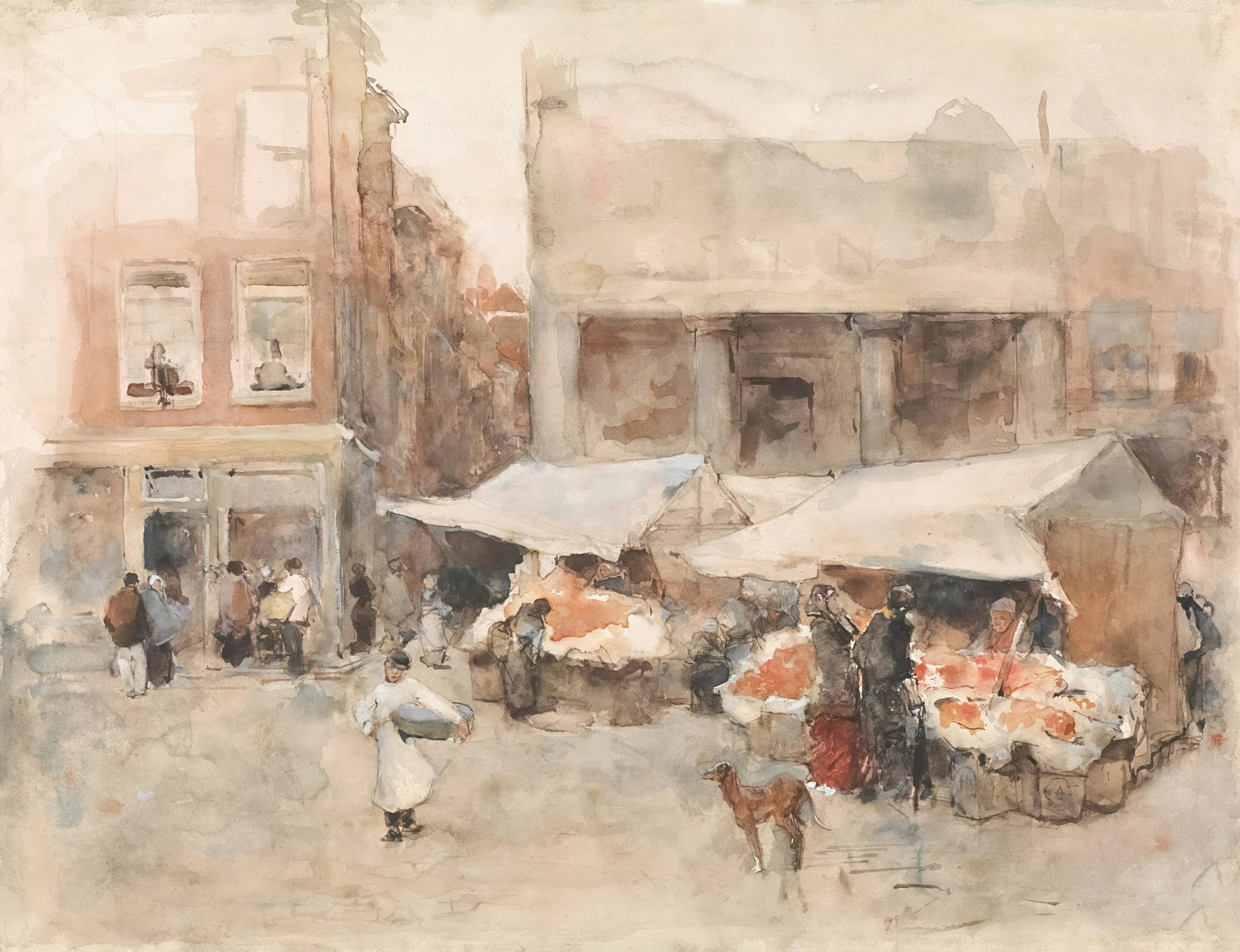
Title: Markt met bloemenstalletjes Publisher: Rijksmuseum Date: 1874 - 1925 Providing institution: Rijksmuseum Aggregator: Rijksmuseum Providing Country: Netherlands Public Domain Markt met bloemenstalletjes - Rijksmuseum, Netherlands - Public Domain.
So how do you decide? Not by volume. The loudest seller is often the most desperate one. Not by ornament. The most decorated booth might be hiding the thinnest goods.
You watch instead. You see who the locals stop for. You notice which seller listens to the whole question before answering, who points you to a competitor because they don't have what you actually need. In a few seconds you're reading an entire history of how this person moves through the world.
That reading is brand, and it always was. Long before anyone drew a logo, people were solving the same problem in that market: can I trust this stranger not to waste my time?
That's the answer I keep landing on. Brand is the microclimate of trust that forms around you before you say a word. It’s a system built from a thousand small signals, most of them not under your direct control, but a few of them sitting where your leverage is. The work isn't making noise in the market. It's becoming the stall the locals nod toward, the one a stranger can look at and think, without quite knowing why, that you know how to solve their problem without wasting their time.